|
 |
|
Army Order 03 2001 Dgms Army Jun 2026For the , the order remains a cornerstone of medical ethics, ensuring that no soldier is turned away with the lazy diagnosis of “constitutional disease.” For the veteran, it is a manual of rights—if you know its pages, you can claim what is rightfully yours. : It likely operates alongside or defines the SHAPE (Psychiatric, Hearing, Appendages, Physical capacity, Eyesight) medical classification system used to determine overall fitness for duty. In the structured hierarchy of the Indian Army, few documents have as profound an impact on the career of a soldier as an Army Order (AO). These directives, issued by the Directorate General of Medical Services (DGMS), serve as the administrative and medical backbone for personnel management. Among these, stands out as a pivotal legislation that redefined how the army screens, categorizes, and manages its human resources from a medical perspective. The biggest challenge was . How does a medical board determine if a soldier’s hypertension or hearing loss is: army order 03 2001 dgms army The categorization directly impacts a soldier's eligibility for retention, promotion, and specific postings. Key Areas Covered by the Order : Advanced screening including urine checks for sugar and proteins to screen for metabolic disorders. These repeat every 5 years thereafter for ORs. The primary mandate of AO 03/2001 is to standardize how health profiles are classified across the ranks. It provides legal and clinical benchmarks to achieve three main goals: For the , the order remains a cornerstone Outlines strict punitive and corrective management for obesity and alcohol dependency. Annual and Periodic Screening Protocols The overarching intent of the DGMS directive is to maintain a young, physically robust, and combat-capable armed force. It systematically addresses several operational areas: : The order (often cited alongside AO 11/2001) introduced a strict "weed out" policy for habitual alcoholics. If an individual in the S3 (Temporary) category due to alcohol dependence relapses, they are typically invalided out of service . These directives, issued by the Directorate General of The DGMS, the apex authority for medical policy and administration within the Army, issued Order 03 in 2001 to address critical gaps in training, administration, or operational readiness. Orders issued under the "03" serial typically denote structural or procedural standing orders—essentially, the "rules of the road" for how specific sections of the Medical Corps must function. The order is used by Medical Boards to decide if a disability is "attributable to or aggravated by military service," which is the key criteria for receiving a disability pension. The policy document is systematically structured into four primary sections to manage the career-long lifecycle of military personnel: Focus Area Functional Scope Policy on Medical Examination |
||
|
|
|
|
|
|
|||||||||||||||||||||||||||||
|
|
|||||||||||||||||||||||||||||
|
|
|
|
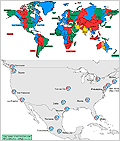
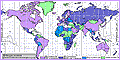
World Time Zone Map with current time (12 HOUR AM/PM FORMAT) Change Time mode: 12 hours (AM/PM) or 24 hours |

|

|
|---|
|
|
Coordinated Universal Time (UTC) or Greenwich Mean Time(GMT).  - places are currently observing Daylight Saving Time (DST) / Summer Time.
World Time Zones maps are property of WorldTimeZone.com and may not be used or reproduced without permission
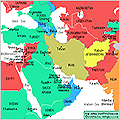
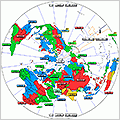
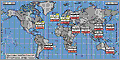
- Pacific centered Map of Time Zones of the World with current time- 24h format and 12h format - Standard Time Zone chart of the World - World Map of Time Zones - Military Time Zones- World Map of Time Zones - History of the Standard Time Zone charts of the World from 1894 to present  - History of the Daylight Saving Time (DST) / Summer Time from 1916 to present - History of the International Date Line from 1844 to present
|
| ||||||||||||||||||||||||||||||||||||||
|
||||||||||||||||||||||||||||||||||||||||


 Quick Reference Time Maps